48 Hours to Build the Future: Our Global Space Hackathon Begins
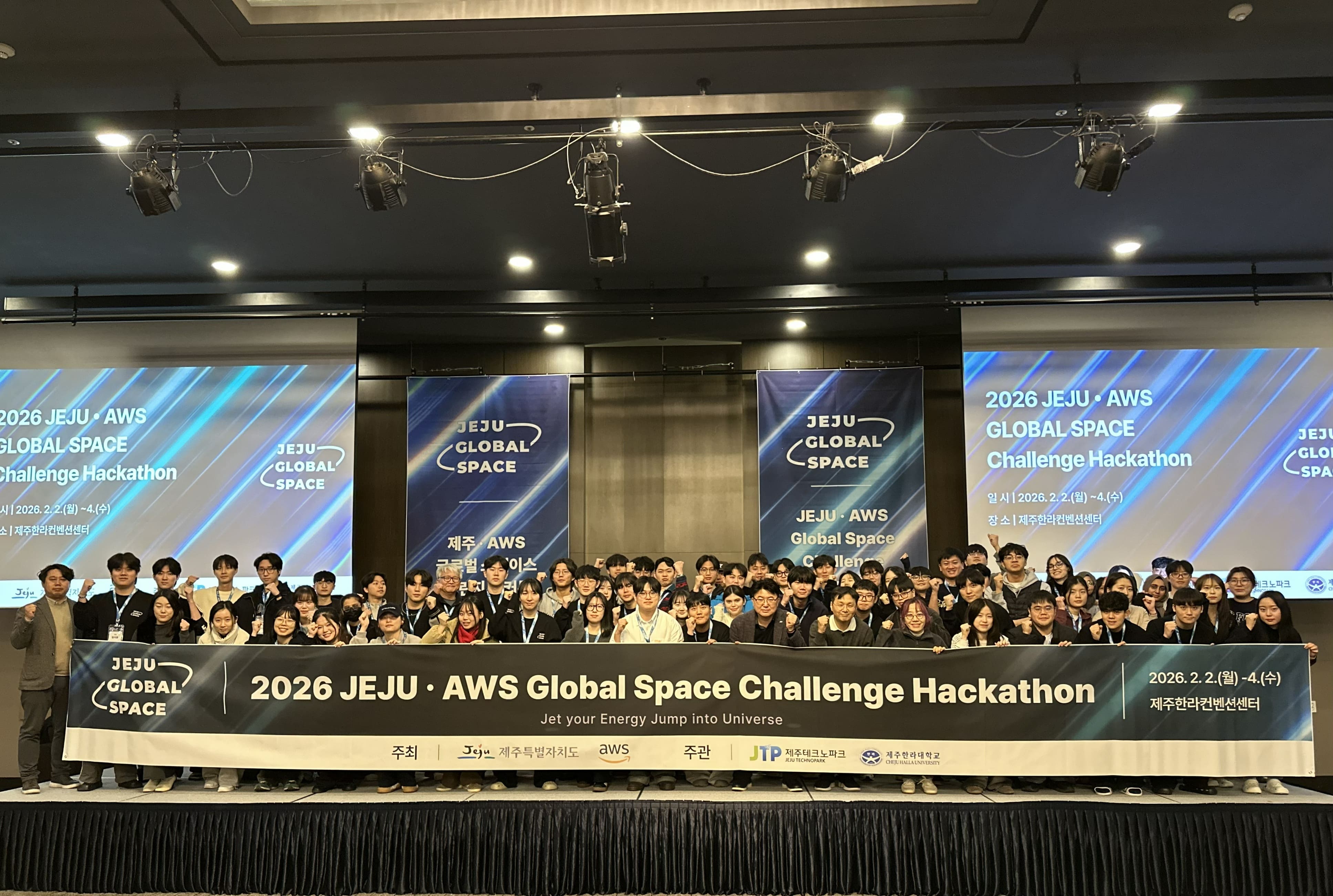
The energy in the Halla Convention Center is electric. 🚀
We’ve just kicked off the 2026 Jeju RISE·AWS Global Space Bootcamp Hackathon, and watching 46 bootcamp participants dive headfirst into this 48-hour sprint has been absolutely thrilling. This is what we’ve been building toward over the past weeks of intensive training.
From Learning to Building
What makes this hackathon special is that we’ve completely flipped the traditional education model. Instead of hypothetical problems or presentation-ready demos, we’ve challenged teams with something far more demanding: solve a real Jeju problem with a working prototype.
Seventeen teams are competing across three challenge areas:
- 🌍 Climate & Energy Crisis Response – disaster management, renewable energy optimization, aquaculture monitoring
- 🛰️ Daily Life & Industry Services – coastal management, blue carbon tracking, UAM safety, tourism innovation
- 🚀 Future Space Industry – space traffic management, radiation warnings, carbon-neutral ground operations
The creativity is stunning. Teams are building everything from AI platforms predicting fish mortality in aquaculture farms, to satellite-LiDAR systems detecting hidden burial sites, to carbon-aware ground station operations for Net Zero Jeju. These aren’t academic exercises – these are solutions that could actually be deployed.
In just 48 hours, participants are going through the complete development cycle: problem definition, data analysis, model design, and service architecture. They’re not just learning – they’re building.
Outcomes Over Process
I told the teams during the opening session: “This hackathon is not an extension of education, but a real-world test. For 48 hours, you’ll experience what it means to define problems and present technological solutions that actually work.”
We’re not judging polished slides or buzzwords. We’re asking: Does it solve a real Jeju challenge? Could it actually be deployed? Is the technology sound and scalable?
What’s Next
The clock is ticking. Teams are already deep into AWS environments, pulling satellite imagery, running spatial analyses, and building APIs. The atmosphere is intense but collaborative – I’ve seen teams sharing insights and debugging together even though they’re competing.
On February 4th, projects will be presented at our RISE·AWS Global Space Forum before industry experts, government officials, and potential investors. The best projects won’t just win prizes – they’ll get corporate partnership pilots, follow-up funding, and direct pathways to employment or startup incubation.
Standing here watching participants wrestle with real data, real constraints, and real deadlines, I’m reminded why we designed the program this way. The real prize isn’t the money – it’s the experience of going from “What if?” to “Here’s how” in 48 hours.
This is applied education at its finest. Let’s see what they create. 🛰️
#ChejuHallaUniversity #AWS #SpaceTechnology #Hackathon #SatelliteData #JejuRISE #Innovation #AI #CloudComputing #ProblemSolving #DesignThinking #Prototyping