RISE (Regional Innovation System & Education)
Leading regional-scale education and innovation programs that connect university capabilities with local industry and public needs.
About
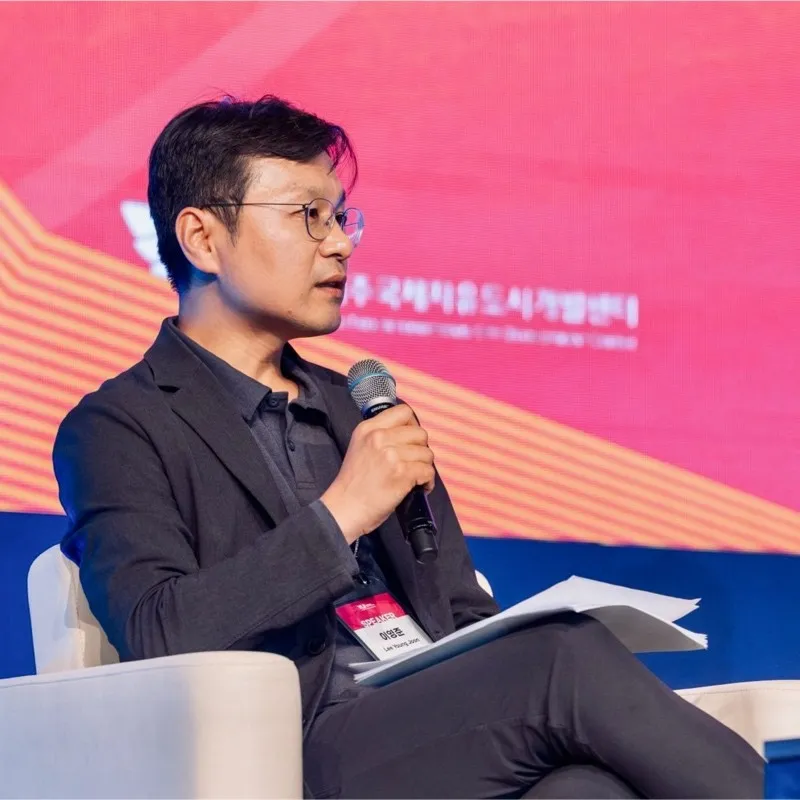
AI professor · builder · collaborator
Professor · Cheju Halla University · CAIO · VP for AX
Dr. Young Joon Lee is a Professor of Artificial Intelligence at Cheju Halla University (Jeju, Republic of Korea). His work focuses on building reliable AI systems that can be deployed in education, public-sector problem solving, and data-driven decision-making, especially where language, evidence, and accountability matter.
His recent efforts center on agentic AI (AI agents that plan, retrieve evidence, and execute tasks), retrieval-augmented generation (RAG), and trustworthy multimodal learning. He also studies how large-scale text signals, such as news and institutional communications, shape expectations and behavior in financial economics.
"Building accountable AI systems for education, sustainability, and real-world decision-making."
Multi-agent orchestration, tool use, verification, and human-in-the-loop evaluation
Extracting structured signals from unstructured text (media, policy, reports)
Grounding, robustness, and transparency across text–image–data pipelines
AI tutoring, course generation, learning analytics, and scalable instructional design
Climate/energy communication, social acceptance, and evidence-based governance
Leading regional-scale education and innovation programs that connect university capabilities with local industry and public needs.
Developing an education platform that supports personalized learning through Socratic tutoring, adaptive learning paths, and evidence-grounded assistance. 4-way collaboration: Cheju Halla University × Saltlux × Yonsei University × KAIST.
Leading a national R&D consortium with Seoul National University, KAIST, and RovoRoad to create the world's first AI-powered autonomous road maintenance system for pothole and sinkhole repair.
Directing an international capacity-building program to train educators and engineers in responsible AI, GenAI practice, and applied machine learning.
Contributing to workshops and collaborations that connect AI methods with ESG, climate action, and responsible innovation.
He designs learning experiences that combine technical rigor with hands-on production. Students learn to build systems end-to-end, data, modeling, evaluation, deployment, and to reason about safety, ethics, and real-world constraints. The goal is to train engineers who can deliver working AI solutions without losing sight of responsibility and human context.
Courses span NLP, MLOps, Robotics, and Operating Systems, each designed to bridge theory and practice through real projects, open-source tooling, and industry collaboration.
Measurable claims, reproducible results, and clear evaluation
Transparent assumptions, traceable evidence, and responsible deployment
Bridging academia, industry, and public institutions
Aligning AI work with long-term social and environmental needs
Staying adaptive as tools, models, and standards evolve
Outside the lab, he enjoys learning languages (currently Chinese and French) and reading about the philosophy of intelligence, especially what "hallucination" reveals about how models represent knowledge.