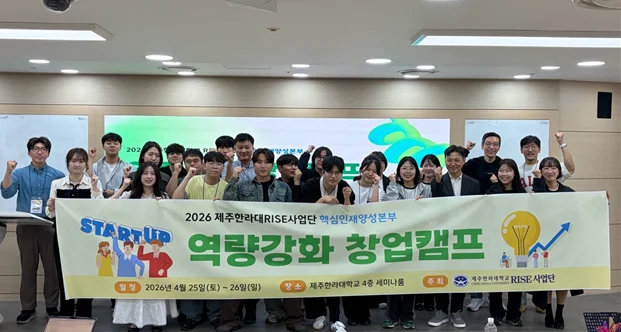
Two months ago, Hanarabong, Saemseung, and Eco Space stood on a stage at Halla Convention Center as the top three teams of the Jeju·AWS Global Space Challenge Hackathon. Today they came back to Cheju Halla University — not to celebrate, but to do the harder work: turning a 48-hour prototype into a company that survives.
The Startup Capacity-Building Camp, hosted by the RISE Project on April 25, was designed for exactly that transition.
Beyond the Idea Competition
In my opening remarks, I tried to frame the day plainly:
“The goal here isn’t another idea contest. It’s whether the technology you’ve already proven through the hackathon — and the problems you’ve identified — can grow into a sustainable business model in the real market. This should be the first concrete step from prototype toward venture.”
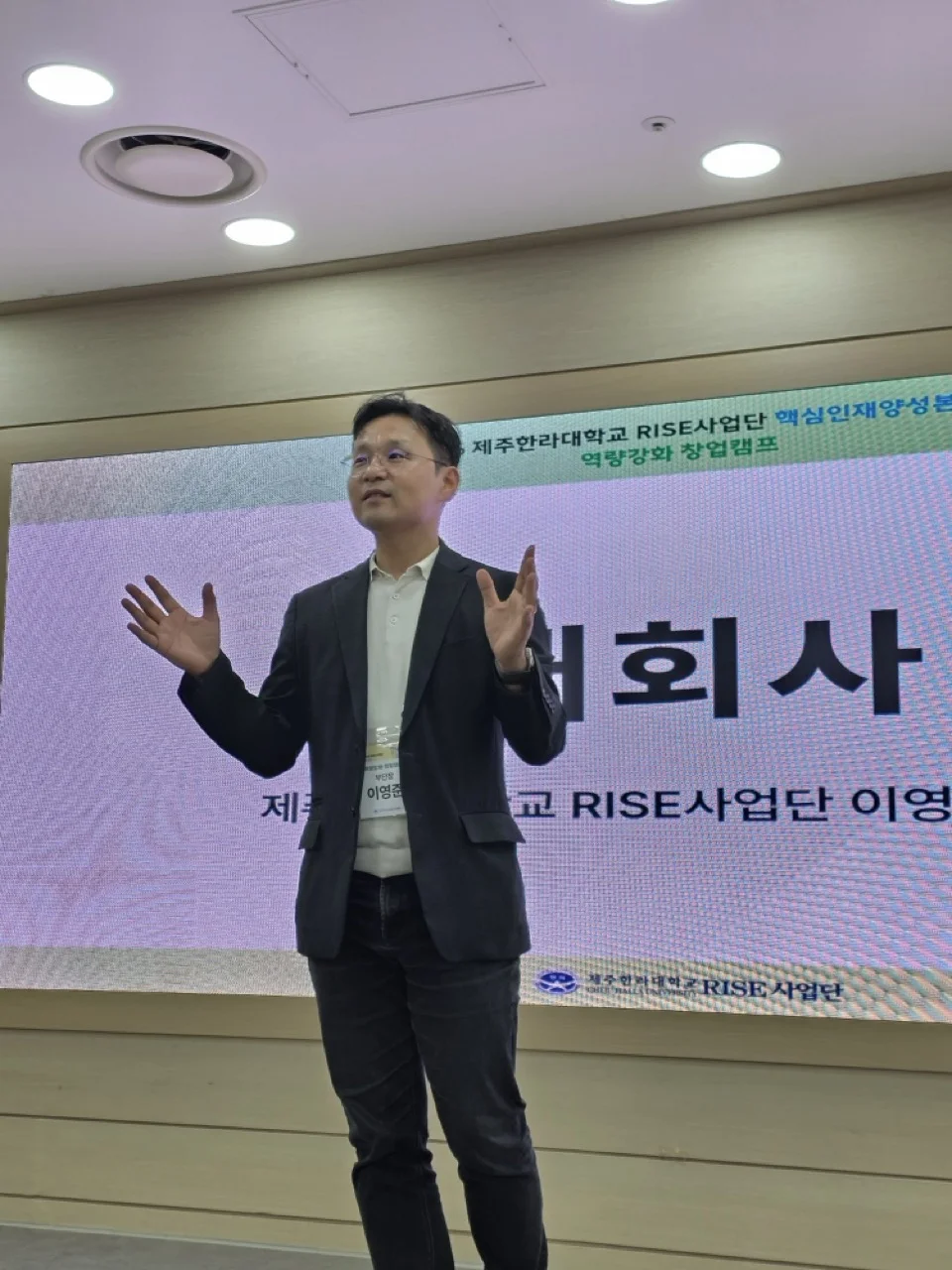
That’s the gap RISE keeps trying to close. We can run great hackathons. We can teach AWS, satellite data, and agentic AI. But the leap from “working demo” to “company someone will pay” is where most university-led innovation programs quietly stall. This camp was our attempt to make that leap less mystical and more mechanical.
Site Visit: Mama Founder
We started outside the classroom. The teams visited Mama Founder, a Jeju-based startup, where CEO Lee Han-sol walked them through “Mama Founder’s Beginning and Journey” — the unglamorous version of a founder’s story, including the lab and the production line itself.
There’s a reason we put a site visit before the workshops. When you’re three months out of a hackathon, every founder talk on the internet sounds the same. Standing in someone else’s actual production facility — seeing the equipment, the inventory, the operational reality — does something a slide deck can’t. It collapses the abstraction.
IR Pitch Deck, Lean Canvas, and Agentic AI
Back on campus, the afternoon was structured around two practical sessions and one strategic one:
- IR Pitch Deck & Lean Canvas — how to crystallize a business plan into the artifacts investors and partners actually read. Less storytelling theory, more “what does slide 4 need to say.”
- Agentic AI for the Startup Environment — how small teams can use agentic AI tooling to do the work of a much larger operation. For three-person student teams trying to validate a market, this isn’t a productivity tip. It’s a survival strategy.
- One-on-one mentor consultations — each team rebuilt their IR Deck and Lean Canvas in real time with a mentor sitting next to them. This is where the day got specific.
Demo Day
The camp closed with a demo day. After roughly two months of refinement since the hackathon, each team pitched the new version of their product — sharper problem statement, clearer market, tighter ask. Format matched a real investor day, because at some point soon, that’s exactly what they’ll be walking into.
The Pipeline Is Producing
What made today feel different from the hackathon weekend is that the follow-on outcomes are no longer hypothetical:
- Five bootcamp participants are currently doing internships at ESTsoft, the AI company we recently announced as our joint training center partner.
- Hanarabong has filed a patent application for the sargassum (괭생이모자반) detection system that won them the grand prize in February.
- In May, the teams will visit AWS Seoul HQ for a startup commercialization program.
Education → hackathon → startup support → industry linkage. That’s the staged pipeline RISE has been building since year one. Today was a checkpoint that the stages are actually connected — that students who entered as bootcamp trainees are now interning at AI companies, filing patents, and pitching to AWS, all inside the same calendar year.
We’ll keep widening it.