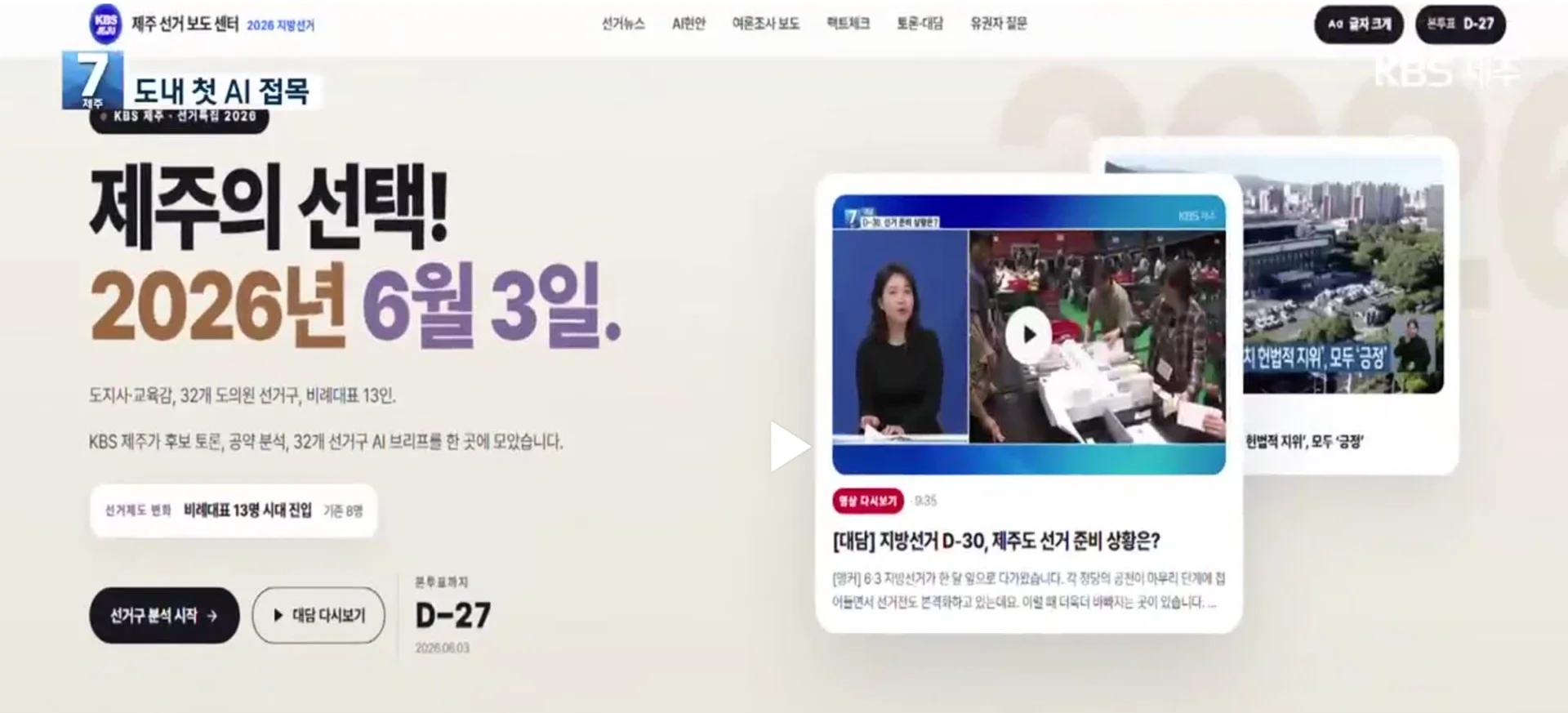
For the June 3 local elections, I worked with KBS Jeju to build the Jeju Election Reporting Center — the first time a Jeju news organization has integrated AI into election coverage.
My piece of it was the AI district analysis layer: a system that ingests local news, public data, and candidate materials for each of the 32 electoral districts, surfaces the live issues, and maps them to candidates’ pledges and points of disagreement. A voter opens their district and sees, in a few minutes, what’s actually contested and where each candidate stands.
In my KBS interview I tried to keep the framing simple:
“AI’s capability has grown to the point where we can analyze district-level issues in a short time, gather them onto a website, and create a space where users can give feedback on them.”
What This AI Is — And Isn’t
The clearest framing I tried to land: this AI is not a prediction engine, and it’s not an answer generator. It is a tool for organizing district-level issues by a consistent standard so 32 districts can be read side by side without one drowning out another.
That distinction sets the expectations for everything else.
Design Constraints I Held the System To
- AI assists, journalists decide. Every district summary passes through KBS’s editorial review before publishing. The AI compresses time; it doesn’t earn trust on its own.
- Sources stay visible. Pledges link back to candidate materials; fact-checks link back to KBS reporting. The reader can always walk back to the primary document.
- No persuasion layer. The system summarizes and organizes — it does not rank candidates, score them, or recommend.
Limits I Want Voters to Know Up Front
I’d rather say these out loud than have someone discover them by surprise:
- Hallucination. Language models confidently fabricate. Editorial review is the backstop, not a hope.
- Data scarcity. Local issues are often not well-datafied. Much of what matters in a Jeju village isn’t on a webpage anywhere.
- Boundary errors. Electoral district lines don’t always match administrative or news boundaries. The model can misattribute an issue, and we have to catch it.
The honest version of this project is that the answers are still in the field. AI can draft fast, but doing it properly takes local understanding, iteration, verification, and revision. There’s no shortcut around the human loop.
The Voter Channel
Because local voices aren’t in the training data, we built a voter question channel. Readers send policy proposals directly to gubernatorial, education superintendent, and provincial council candidates, routed by office and district so candidates receive something usable. It’s the part of the site that lets the un-datafied speak for itself.
Why District-Level
National races get the cameras. District-level races are where most voters arrive uninformed — not because they don’t care, but because the information was never assembled in a usable form. That’s the gap this layer was built to close.
AI isn’t a cure-all. Neither is an election. What ultimately decides whether this hub helps Jeju voters on June 3 is the same thing that decides every election: human time, effort, and responsibility — from journalists, from candidates, and from the voter standing in the booth. The AI just makes the standard consistent enough that the human work has somewhere to land.
→ Visit the Jeju Election Reporting Center → Watch the KBS report