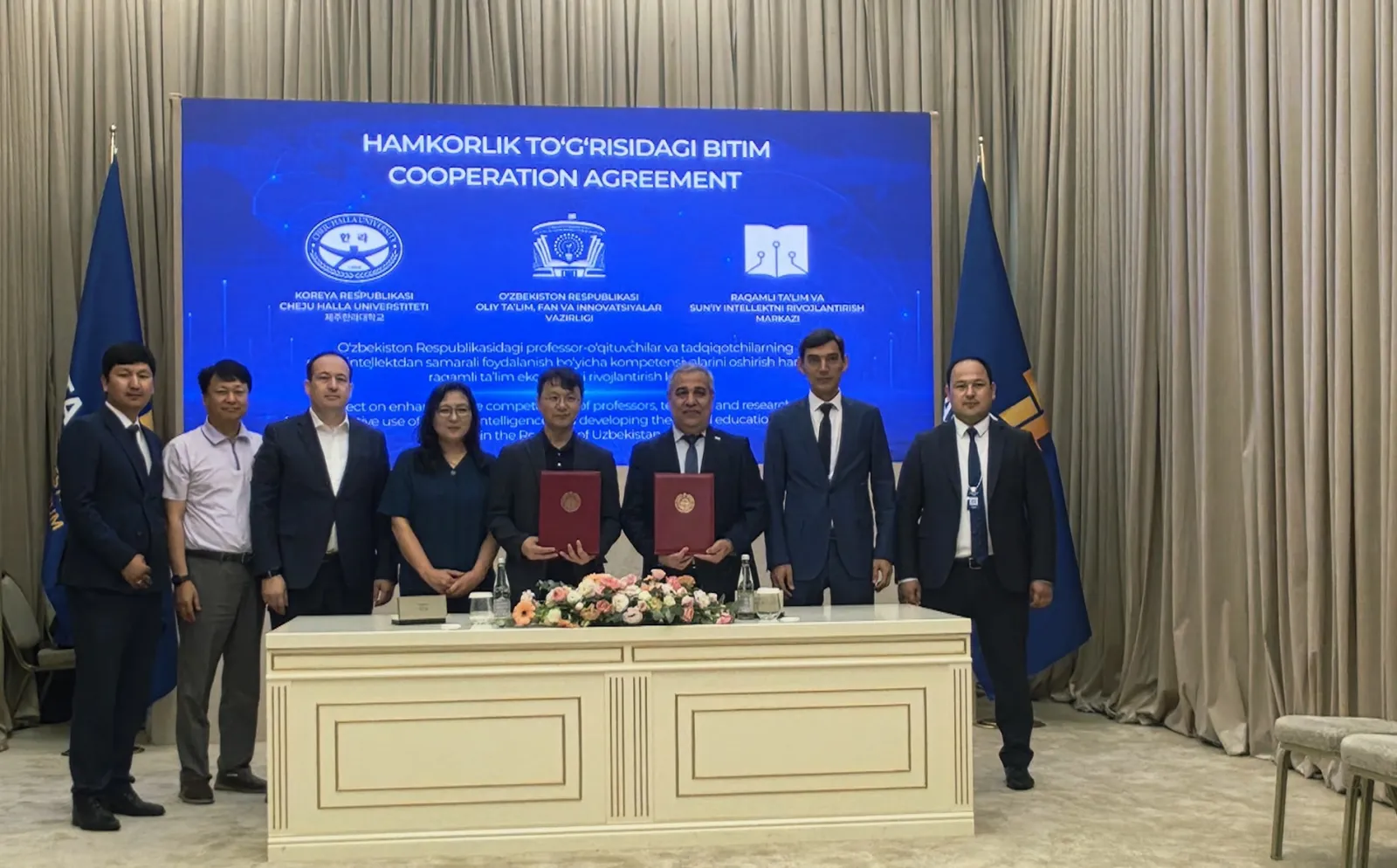
This week the Central Asian Expocenter in Tashkent is hosting the Tashkent International Investment Forum — halls full of energy deals and infrastructure pipelines. We came to sign something much smaller: a one-page agreement about training teachers.
The Signatures
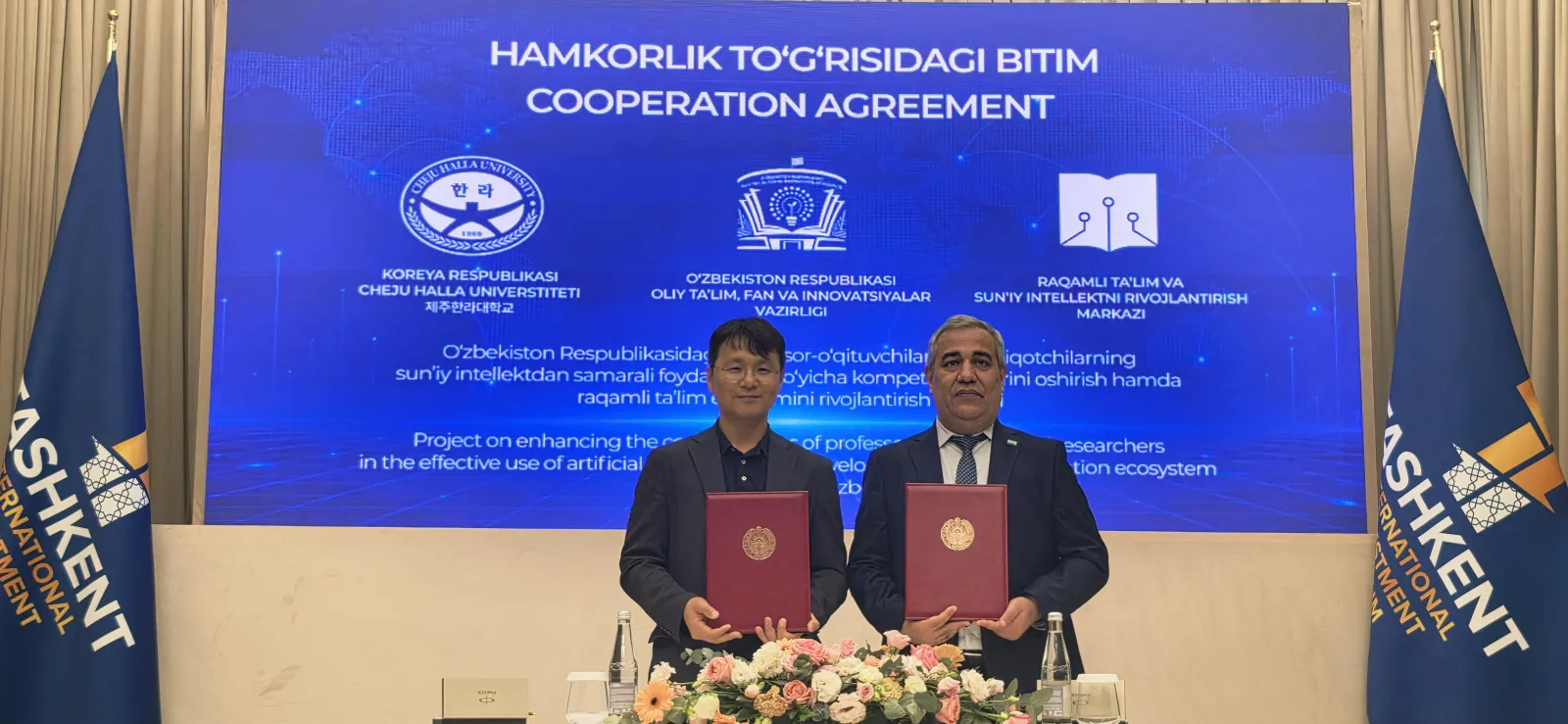
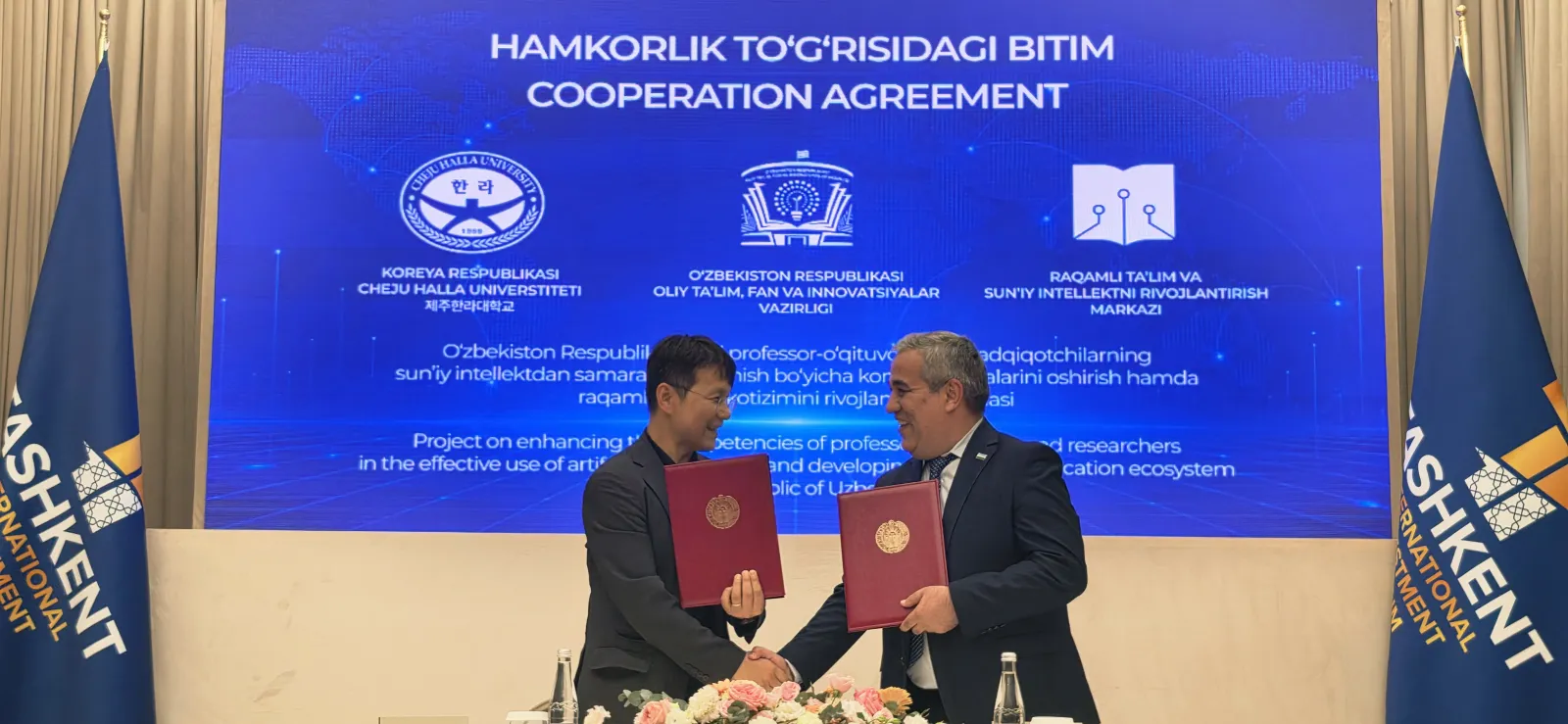
The banner carried three names: Cheju Halla University, Uzbekistan’s Ministry of Higher Education, Science and Innovation (MoHESI), and the ministry’s Center for the Development of Digital Education and AI Technologies. I signed for our university as Vice President for the AX Initiative and Chief AI Officer. Deputy Minister Salomov Uktam Rahimovich signed for the ministry. The Center is named in the agreement as the partner that will run the work.
From Students to Their Teachers
For two years our work in Uzbekistan had a simple shape. Through our International Development Cooperation Center, and with support from KOICA’s Civil Society Partnership Program, we built an AI Training Center with Tashkent International University and taught students directly — two cohorts, a real lab, Microsoft Azure certifications, a graduating class this week.
Teaching students works, but it doesn’t last. When we leave, the capacity leaves with us. The real shortage in Uzbekistan is faculty: there aren’t enough professors and researchers who are confident teaching AI. So this agreement moves up a level. Instead of teaching more students, we train the trainers — the faculty who then teach their own students, year after year.
What the Agreement Does
It’s a non-binding framework, not a contract. It commits us to a model, not to money.
The core is a Training-of-Trainers program: workshops of about five days and twenty-five hours, aligned to the Microsoft AI-901 and Foundry standard, ending in certification. Underneath runs the AI Professor platform — the toolset we’ve built to help an instructor generate lecture material, set and grade work, and actually deliver a course with AI. The agreement also covers certification tracks, knowledge exchange, and a path to scale across the system. It runs three years and renews unless someone steps away.
Why a Ministry Signs
A workshop reaches a room; a ministry reaches a system. With MoHESI providing the policy weight and the Center handling implementation, our curriculum stops being a guest lecture and becomes part of how a country trains its educators. That is the difference between teaching in Uzbekistan and helping Uzbekistan teach itself.
What Comes Next
This is a start. The framework points toward a continuation we hope to propose to KOICA for 2027 — and “hope” is the honest word, since that decision is theirs. Before then comes the real work: turning a one-page understanding into a curriculum, a cohort of trainers, and a platform that holds up in a classroom in Tashkent.
We spent two years earning the trust to be in that room. Signing for the teachers, rather than for more students, is the bet that the most useful thing we can leave behind is the people we help become teachers.