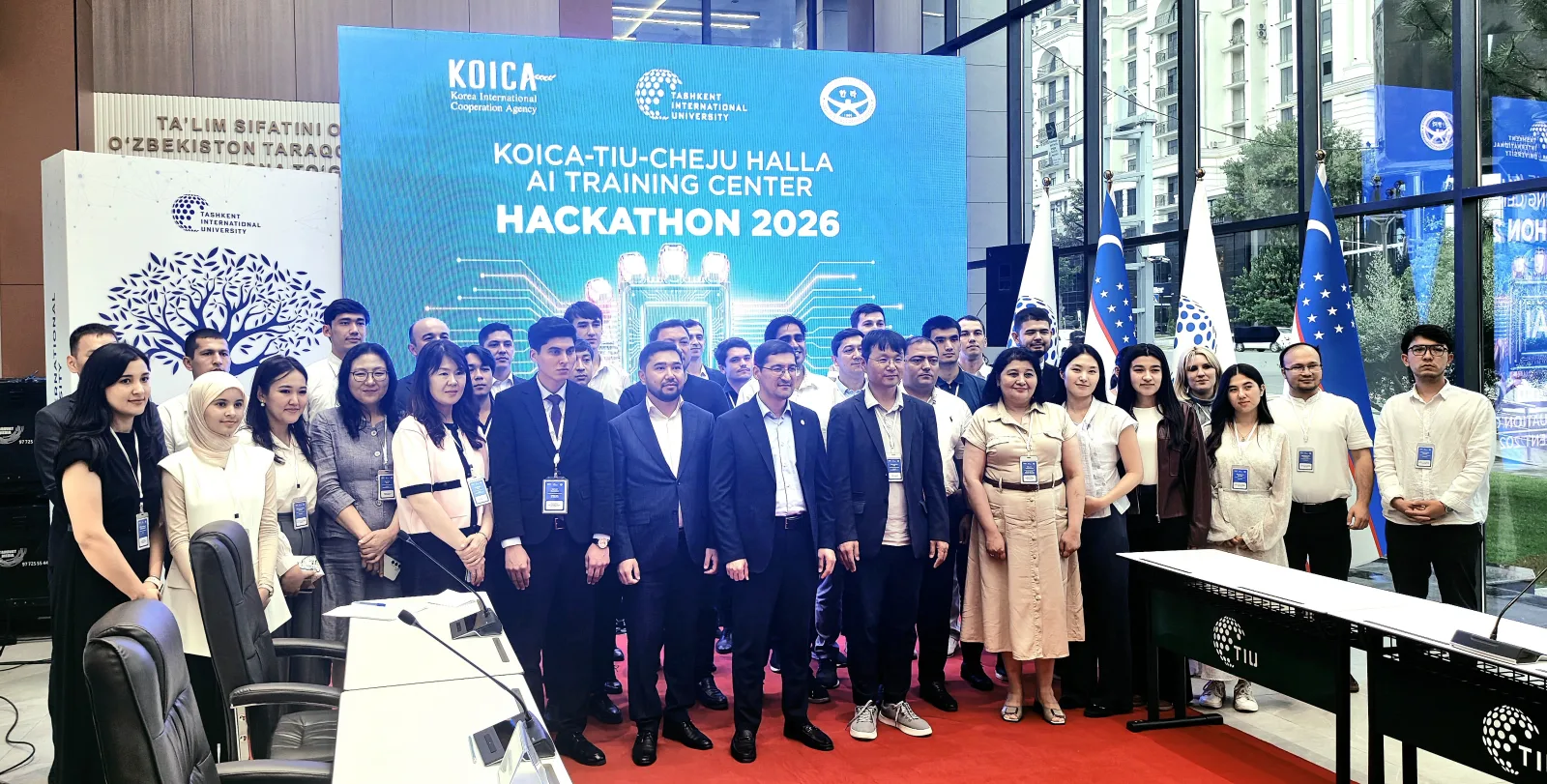
Some days a project shows you its whole arc at once. On June 20 in Tashkent, our KOICA-TIU AI Training Center spent the morning handing out certificates and the afternoon watching students turn what they had learned on real problems. One cohort, two halves of the same idea.
The Graduation
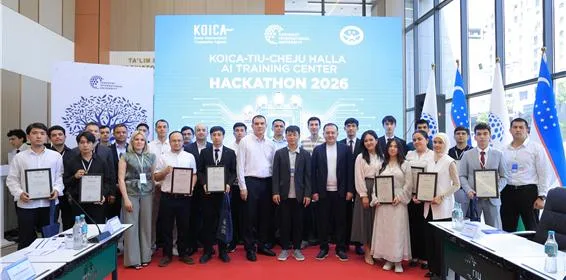
Forty-eight people enrolled this spring. Thirty finished — meaning they completed at least two of our four courses across twelve weeks — and with the local tutors and invited instructors counted in, 39 received certificates in all.
The room wasn’t what you would expect from an “AI course.” TIU students, of course, but also practitioners from Uzbekistan’s Ministry of Defense, the Central Bank, the UN, and other institutions. Their backgrounds ran through law, economics, and public administration — not just computer science. That mix is the point: AI work belongs to people who have problems to solve, not only to people who write code.
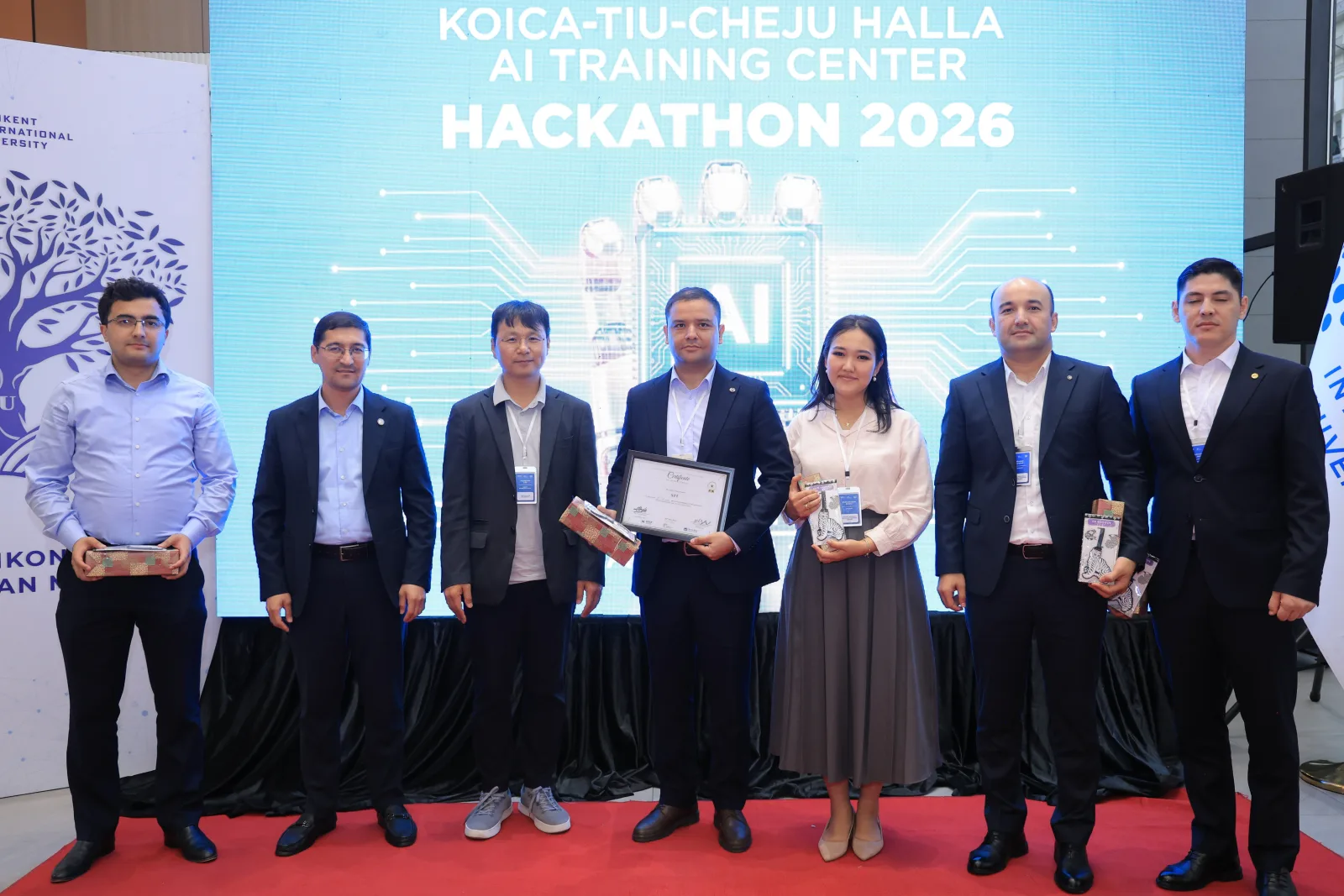
TIU Rector Iskandar Yuldashev and I presented the certificates together, with TIU Vice-Rector Sherzod Khannaev and our AI Center Director, Sarvarjon Komilov, alongside.
Training the Trainers
The quieter milestone is who we trained to keep training. Through a Training-of-Trainers (ToT) track we brought local tutors up to the point where they can run the courses themselves. That is the start of local ownership — the thing that actually decides whether a program survives after the funding ends.
And the program grew. We went from two courses to four:
- Azure AI Fundamentals
- Generative AI & Prompt Engineering
- AI Convergence Solution Consulting
- AI Engineering & MLOps
Broader, and more hands-on, than year one.
AI for Uzbekistan: The Hackathon
In the afternoon the certificates came off the wall and the laptops came out. The format was deliberate: companies brought real problems from their own operations, and five teams had to propose AI-based answers. Six of us judged — I was one — weighing technical implementation, creativity, business value, and how well each team could present.
The grand prize went to “Voice the Ballot” (Team 04): a data platform that turns speech into text across eleven Central Asian languages, Uzbek among them. For a region whose languages are thin on the ground in most AI datasets, that is not a toy. It is infrastructure.
The rest of the field showed the same instinct for real problems — an LLM-based intent-and-emotion analysis assistant, an AI price-comparison search engine, an AI recruitment platform, and a flight-delay notification system.
Beyond One Cohort
The day reached past the room. Uzbekistan’s national broadcaster, O’zbekiston 24, carried the ceremony and the hackathon nationwide, framing AI talent as a national priority. And TIU is opening its own AI department this September, building on the center we started together.
A few practical notes for the people doing the work: the Microsoft Azure AI-900 exam is being re-sat on June 27 — the certification is rolling over to AI-901 at the end of the month — and we are keeping up local-language study support so that language never decides who passes.
I said it at the ceremony and I will say it here: AI is not a technology for engineers alone. It is a tool for anyone trying to solve a real problem. Which is why the goal that matters most isn’t how many students we teach. It is whether, after we are gone, Uzbekistan can train its own. Building that local capacity is the whole point.
Thirty certificates and five demos closer to a regional hub for AI talent development in Central Asia, one cohort at a time.