ESG Topic Coverage in Korean Capital Market Analyst Reports
Topic modeling study of how ESG issues are covered in Korean equity analyst research reports, revealing coverage patterns, trends, and sector-level variation across 36 discovered topics.

Overview
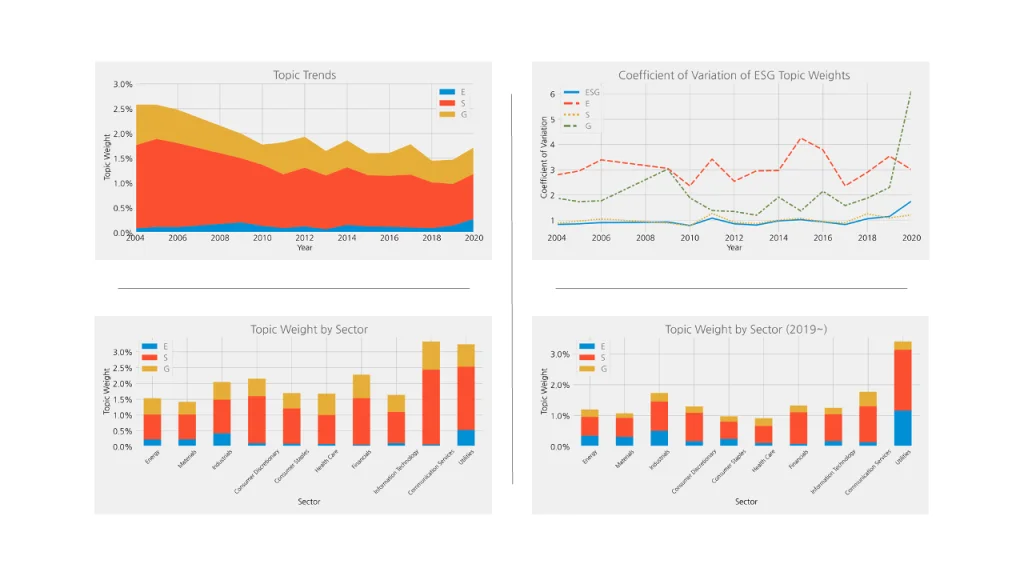
As ESG investing has grown from a niche practice to a mainstream allocation criterion, a natural question emerges: how are financial analysts actually incorporating ESG considerations into their research? This project answers that question for the Korean capital market by applying topic modeling to a large corpus of Korean equity analyst reports and measuring the coverage, distribution, and trends of ESG-related topics discovered in the text.
Rather than imposing a predefined ESG taxonomy, the analysis lets the topics emerge from the data — producing 36 distinct topics that organically reflect the ESG issues analysts were writing about during the study period.
Technical Approach
The project applies unsupervised topic modeling to analyst research reports using the ekorpkit Python package — a Korean NLP toolkit — for text preprocessing and topic extraction. With 36 topics identified, each report receives a probability distribution across all topics, allowing the analysis to track how the weight of ESG-related topics shifts over time and varies across industry sectors.
Key analytical dimensions include:
- Topic composition: Identifying which of the 36 topics correspond to Environmental (E), Social (S), and Governance (G) concerns, as well as ESG investment themes as a distinct topic cluster
- Temporal trends: Tracking how the proportion of ESG-related content changes across the study window, revealing when analysts began integrating ESG more systematically
- Sector variation: Comparing topic weight distributions across industries, capturing meaningful differences in how, say, energy or manufacturing analysts write about ESG versus consumer or financial sectors
Key findings show that ESG topics collectively represent roughly 2% of topic weight on average in analyst reports. Social topics dominate due to their overlap with traditional CSR coverage, while Environmental topics — despite carrying the smallest average share — show the highest temporal volatility and a recent upward trend. Sector-by-sector comparison reveals substantial heterogeneity in which ESG issues receive attention by industry.
Significance
This work provides one of the first systematic quantitative descriptions of ESG integration in Korean sell-side equity research. The findings offer a ground-level picture of how financial professionals translate the ESG agenda into their written analysis — an important complement to survey-based or rating-based studies. The increasing weight of environmental topics in more recent reports aligns with global regulatory pressure and investor demand, suggesting that analyst attention is responding to market signals.
For investors, the sector-level topic variation provides insight into where ESG risks and opportunities are most actively discussed. For researchers studying the diffusion of ESG norms into financial markets, this methodology offers a replicable framework applicable to analyst report corpora in other markets.