Overview
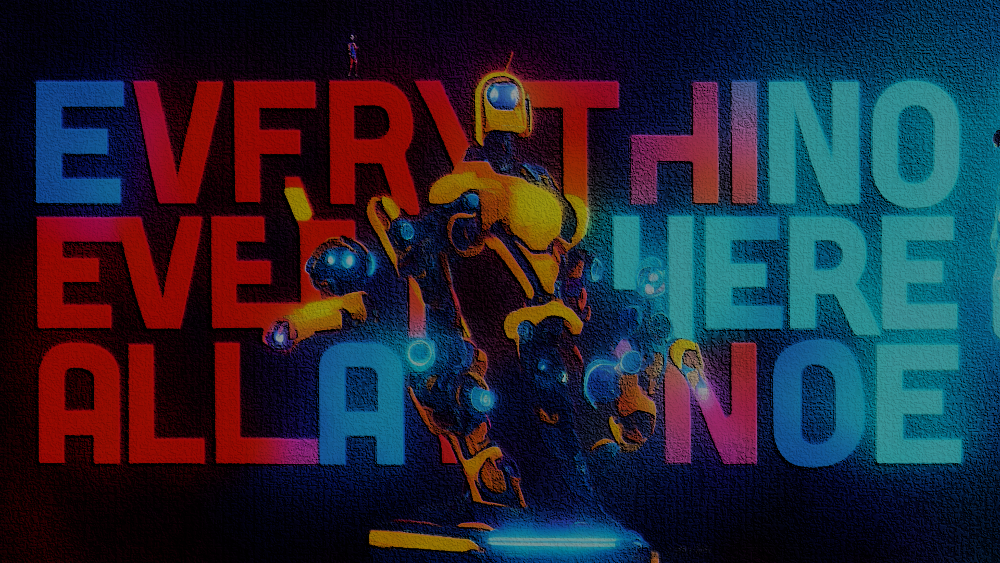
This talk, subtitled Infinite Possibilities: AI’s Journey Towards Understanding Everything, Everywhere, All at Once, takes its name and spirit from the film — a meditation on complexity, interconnectivity, and the possibility of holding contradictory truths simultaneously. AI research is at exactly such an inflection point.
The presentation opens by asking what intelligence actually is. Using IBM’s Watson as a foil, it draws a distinction between information retrieval and genuine understanding. Watson’s Jeopardy! victory was a triumph of fast pattern-matching over a structured corpus — impressive, but fundamentally different from the world-modelling that underlies human reasoning. The central thesis is that the next frontier is not bigger models but better world models: internal representations that let AI systems interpret context, not just retrieve tokens.
Key Themes
From Turing to Transformers. The talk traces a conceptual line from Alan Turing’s Imitation Game through the Neural Turing Machine, attention mechanisms, and the Transformer architecture. Each step is framed as an attempt to move from rote imitation toward genuine comprehension.
Large Language Models and Their Limits. GPT-4 and its contemporaries generate impressively coherent text, yet they lack grounded world models. The presentation examines hallucination, knowledge graphs, and retrieval-augmented generation as partial solutions to this gap.
Cutting-Edge Tools. The second half surveys the 2023 toolkit: LangChain, LlamaIndex, Segment Anything Model (SAM), DINOv2, and ImageBind — situating each within the broader arc from perception to reasoning.
ESG and Responsible AI. The talk closes by connecting AI capability to societal responsibility, arguing that understanding everything carries an obligation to act well — linking the technical themes to the ESG and sustainability research that runs throughout this body of work.
The 119-slide deck is dense by design: the goal is to convey the sheer breadth of the AI landscape as it stood in mid-2023, and to argue that only researchers comfortable moving across all of it will be able to shape what comes next.