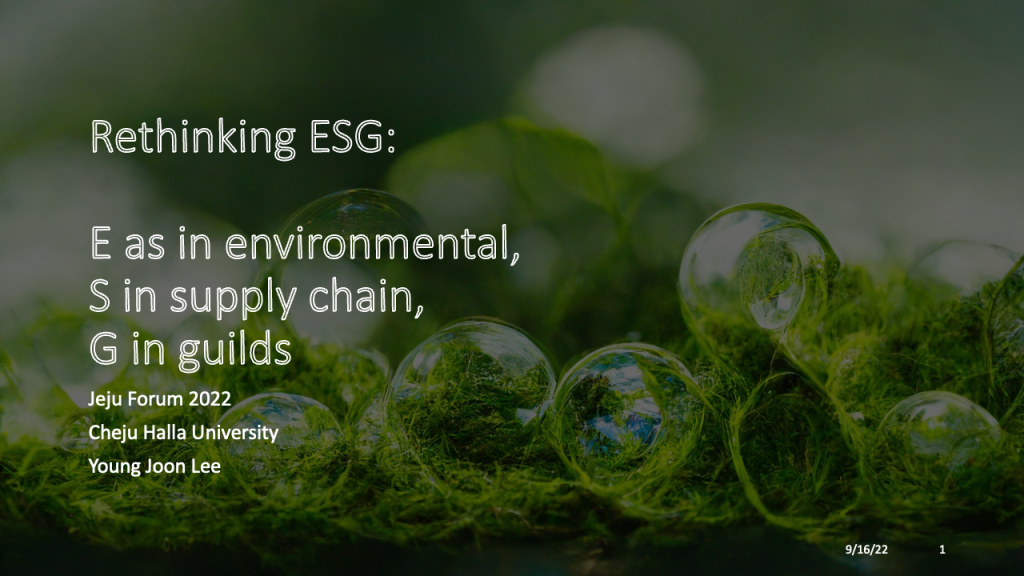
Overview
ESG — Environmental, Social, and Governance — has attracted more than $35 trillion in assets managed under its framework, yet the concept is under fire from multiple directions. Conservatives call it a “climate cartel”; insiders accuse firms of greenwashing; regulators are scrutinising institutions from Goldman Sachs to Deutsche Bank. This talk argues that the problem is not ESG’s goals but its architecture, and proposes a structural fix.
The Three Problems with ESG as Currently Practised
ESG bundles incommensurable objectives into a single score. This prevents coherent trade-offs. It also creates misleading reward signals: ESG scores from different rating agencies correlate only about 50% of the time, compared to 99% for credit ratings from competing agencies. The score can be gamed; the underlying behaviour may not change at all.
Separating E, S, and G
The talk proposes treating the three letters as distinct instruments rather than a composite index:
- E (Emissions): Focus squarely on carbon — specifically Scope 3 emissions embedded in supply chains, which account for 60–80% of a firm’s total footprint. These are indirect, remote, and largely outside direct corporate control, which is exactly why they require industry-wide coordination rather than firm-level disclosure.
- S (Supply Chains): Traceability and transparency are the operational challenge. Blockchain is examined as a mechanism for providing tamper-proof, auditable records of emissions claims — converting environmental assertions into verifiable evidence rather than marketing copy.
- G (Guilds): Rather than conventional board-level governance, the talk proposes guild-like industry cooperatives modelled on medieval craft guilds — self-regulating bodies that set quality standards and enforce compliance through peer accountability, not just regulatory mandate.
Asia-Pacific Energy Transition
Drawing on the Asia Pacific Energy Transition Readiness Index, the presentation highlights a striking perception gap: survey respondents expected carbon emissions to be 39% lower in 2030 than in 2005, while actual emissions had risen roughly 50% over that period. Five barriers to progress are identified — funding, knowledge, technology, policy, and supply chain coordination — with particular emphasis on the need for Northeast Asian cooperation to unlock private-sector participation.