
AI professor, builder, CAIO
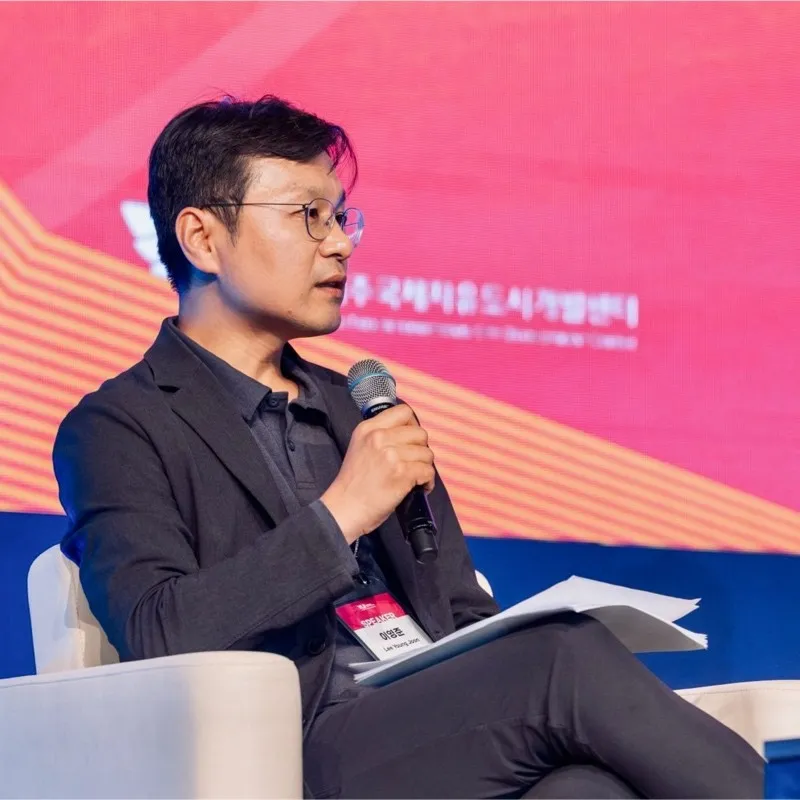
Young Joon Lee
I build accountable AI systems for education, public institutions, and real-world decisions.
01 / Selected work
Systems built for real institutions.
All projects
education / 2025
Agentic RAG Technology for Intelligent Educational Platforms
Building a next-generation AI tutoring platform fusing Agentic RAG with Socratic dialogue — RISE Industry-Academia Joint Research with Saltlux, Yonsei University, and KAIST.
View projecteducation
Agentic AI-Based Intelligent Education Platform
Joint development of AI Professor System integrating Saltlux LUXIA LLM and Cheju Halla's education platformresearch
Development of a Pathology Database for an Internet Hospital Platform
AI-powered virtual physician for healthcare delivery with pathology database development and NLP applications02 / Current responsibilities
Teaching, institutional change, and applied research.
- 01
Associate Professor
Department of AI, Cheju Halla University
- 02
CAIO and VP for AX
Office of AI Innovation, Cheju Halla University
- 03
Center Director
Natural Language Research Center
- Agentic AI Platform
- RovoRoad Jeju RISE
- TIU AI Center
- STAI Workshop
03 / Recent activity
Notes from the field.
All writing- 01
A Ladder with the Air Force on It
Fourteen institutions launched the A2CL council in Incheon, pairing Jeju's NewSpace industry with Incheon's aircraft maintenance base. The rung I keep pointing at is the one nobody expects.
- 02
The Agreement Came After the Work
KBS Jeju and Cheju Halla University signed an AI cooperation agreement, but the real decision was made last spring, when we spent an election finding out whether we could work together.
- 03
RovoRoad Hits the Road: Our First Jeju Field Demonstration
On Jeju's public roads this June, our AI spotted the potholes and a robot filled them — the first field demonstration of the RovoRoad unmanned repair system, and the close of Year 1.
04 / Research
Recent publications.
Publication archive- 01
PDTune: Database Parameter Dependency-Aware Optimization
KIISE Transactions on Computing Practices (KTCP)
- 02
Prediction of Road Maintenance Intervention and Assessment of Influencing Factors with ML-SHAP: Focusing on Road Traffic Conditions in Jeju
Journal of Korean Society of Transportation
- 03
A Case Study in Jeju Island of Automated Pothole Management Framework
International Journal of Highway Engineering